FindMyTBR
Friedrich Nietzsche audiobooks
See which Friedrich Nietzsche books are available as audiobooks and where to listen — across Spotify, Apple Books, Audible, and Amazon.
About Friedrich Nietzsche
Friedrich Nietzsche (1844–1900) developed his philosophy during the late 19th century. He owed the awakening of his philosophical interest to reading Arthur Schopenhauer's Die Welt als Wille und Vorstellung (The World as Will and Representation, 1819, revised 1844) and said that Schopenhauer was one of the few thinkers that he respected, dedicating to him his essay Schopenhauer als Erzieher (Schopenhauer as Educator), published in 1874 as one of his Untimely Meditations.
Since the dawn of the 20th century, the philosophy of Nietzsche has had great intellectual and political influence around the world. Nietzsche applied himself to such topics as morality, religion, epistemology, poetry, ontology, and social criticism. Because of Nietzsche's evocative style and his often outrageous claims, his philosophy generates passionate reactions running from love to disgust. Nietzsche noted in his autobiographical Ecce Homo that his philosophy developed and evolved over time, so interpreters have found it difficult to relate concepts central to one work to those central to another, for example, the thought of the eternal recurrence features heavily in Also sprach Zarathustra (Thus Spoke Zarathustra), but is almost entirely absent from his next book, Beyond Good and Evil. Added to this challenge is the fact that Nietzsche did not seem concerned to develop his thought into a system, even going so far as to disparage the attempt in Beyond Good and Evil.
Common themes in his thought can, however, be identified and discussed. His earliest work emphasized the opposition of Apollonian and Dionysian impulses in art, and the figure of Dionysus continued to play a role in his subsequent thought. Other major currents include the will to power, the claim that God is dead, the distinction…
Friedrich Nietzsche writes about Philosophy, Friedrich Wilhelm Nietzsche (1844-1900), Ethics, Nietzsche, friedrich wilhelm, 1844-1900, German Philosophy, and Richard Wagner (1813-1883). Their best-known work is Also sprach Zarathustra: Ein Buch für Alle und Keinen.
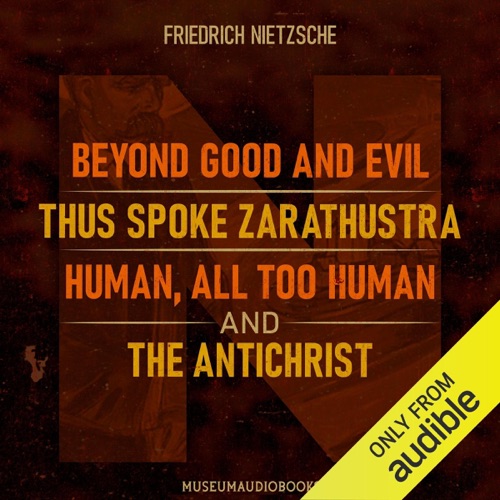
On FindMyTBR we track 40 books by Friedrich Nietzsche, 35 of them confirmed as audiobooks on Spotify or Apple Books — including 150 quotes by Friedrich Nietzsche: Great philosophers & their inspiring thoughts, Así habló Zaratustra [Thus Spoke Zarathustra], and Beyond Good and Evil. Full availability across Spotify, Apple Books, Audible, and Amazon is below.
Books by Friedrich Nietzsche

![Así habló Zaratustra [Thus Spoke Zarathustra] cover](https://is1-ssl.mzstatic.com/image/thumb/Music116/v4/c9/68/ec/c968ecab-d188-8bdb-38c3-4f09ed76b9bf/9781004134397.jpg/500x500bb.jpg?default=false)




Availability reflects titles we've confirmed on Spotify or Apple Books; a book with no badge just hasn't
been confirmed on a streaming service yet — you can still search Audible and Amazon for it.
Covers via Open Library.
Search your whole Goodreads shelf →